kwes. on Kinds
Words: Lanre Bakare
2339 words, 00:07:47
After a long stretch working behind the scenes, kwes. returns with Kinds – a record shaped as much by time and family life as by sound. In conversation with Lanre Bakare, kwes. talks about the slow unravelling of the album over several years, including the unexpected role of Center Parcs in unlocking the process, and why stripping things back felt essential this time.
Lanre Bakare: kwes., it’s been a little while since your last record Songs for Midi came out. But am I right in thinking you’ve been working away on this for a few years now?
Kwes: Yeah that EP came out I think 2018, so that's about seven years ago. So yeah, maybe for the last five, six years, I'd been working on what was going to become the second album. And I think there was some stuff I'd worked on before that I was thinking of putting on what was going to be the LP2. Then I kind of jettisoned most of it and what was left became some of the Rye Lane soundtrack, kind of repurposed, chopped up into smaller pieces.
Around mid-2024, I was completely knackered and thankfully a pre-booked trip to Center Parcs had come around by then. I had been wanting to go for ages, I remember those adverts as a kid. They looked amazing with the whole crystal maze feel and the big dome thing.
LB: Which one did you go to?
K: We went to the one in Suffolk. I loved it, cycled for hours on the flat forest ground, did loads of indoor and outdoor activities - indoor climbing to archery. Sauna and pool table in the self-catering accommodation we stayed in. It was indeed much needed.
LB: What happened when you were there to make the record possible?
K: I was simply able to properly switch off for a minute. And remembered that holidays existed haha. Then when we got back, around 5 days later, that evening, I put the kids to bed and rather than head to sleep, knackered from the journey back, I felt like a kid again, rejuvenated. Perhaps the fulfilment of a childhood dream going to Center Parcs, whilst savouring that experience was responsible. This record had been at the back of my mind for so long and thankfully it had become super clear to me on what it had to be or more accurately what the process had to be.
The colour references in this case are more related to memories and emotions, particularly landscapes and kinds of perspective – visually and personally and how they make me feel, really.
Listen:
kwes. ˇ
‘Black (Grey)’
LB: The magic of Center Parcs. That's a solid recommendation … It's interesting looking back at past interviews you've done because there's always this recurring theme of anticipation around your solo work. People asking when's the new record coming? Which gives the impression that here's a guy who's just working away on these solo projects and procrastinating, but obviously you've got so many other things kind of lined up. Does that production work or working on a score like you did for Rye Lane influence your records or are those things completely separate?
K: They might influence my records a little bit, but I think they're pretty separate, to be honest. When I'm doing the production/songwriting for other people or more recently the film/tv stuff, I'm working in service to the artist/band/picture, though there are pockets of freedom to express myself. Whereas with my own stuff, I'm kind of just painting, having fun, channeling the ideas straight through me.
LB: What was the starting point for this record? Is it right to call it an ambient record?
K: I guess it is. A friend of mine, who I meet quite regularly on the school run, described it as a modern classical record, which is a new one for me haha. But I guess on face value it's an ambient record, or a noise record or a drone record. But the melodies are all in there. They ease you into it, like you can hear the melodic passages throughout the more you listen.
LB: I feel like quite a lot of the early work there's this loud sound collage thing where like there's a lot going on sonically in your music. This record felt really internal and set back, but am I reading that right?
K: Yeah just really trying to kind of strip things back as much as possible, trying not to overthink things and looking to get to the essence or heart of it.
LB: And were there certain influences that you were thinking of when you were making the record? Like, either musically or thematically or whatever.
K: Initially I wasn't actively thinking of anything, I was kind of thinking, let me just play some melodies and then strip it back as much as possible. It's just pure melodies. Now that I think about it, maybe there were sonic influences of shoegaze and... noise and drone etc. You can kind of hear elements of it on the ilp, the first LP. I'm not sure whether people heard/caught those references on it. With this one - Kinds, I'm trying to push it even further. Does that make sense?
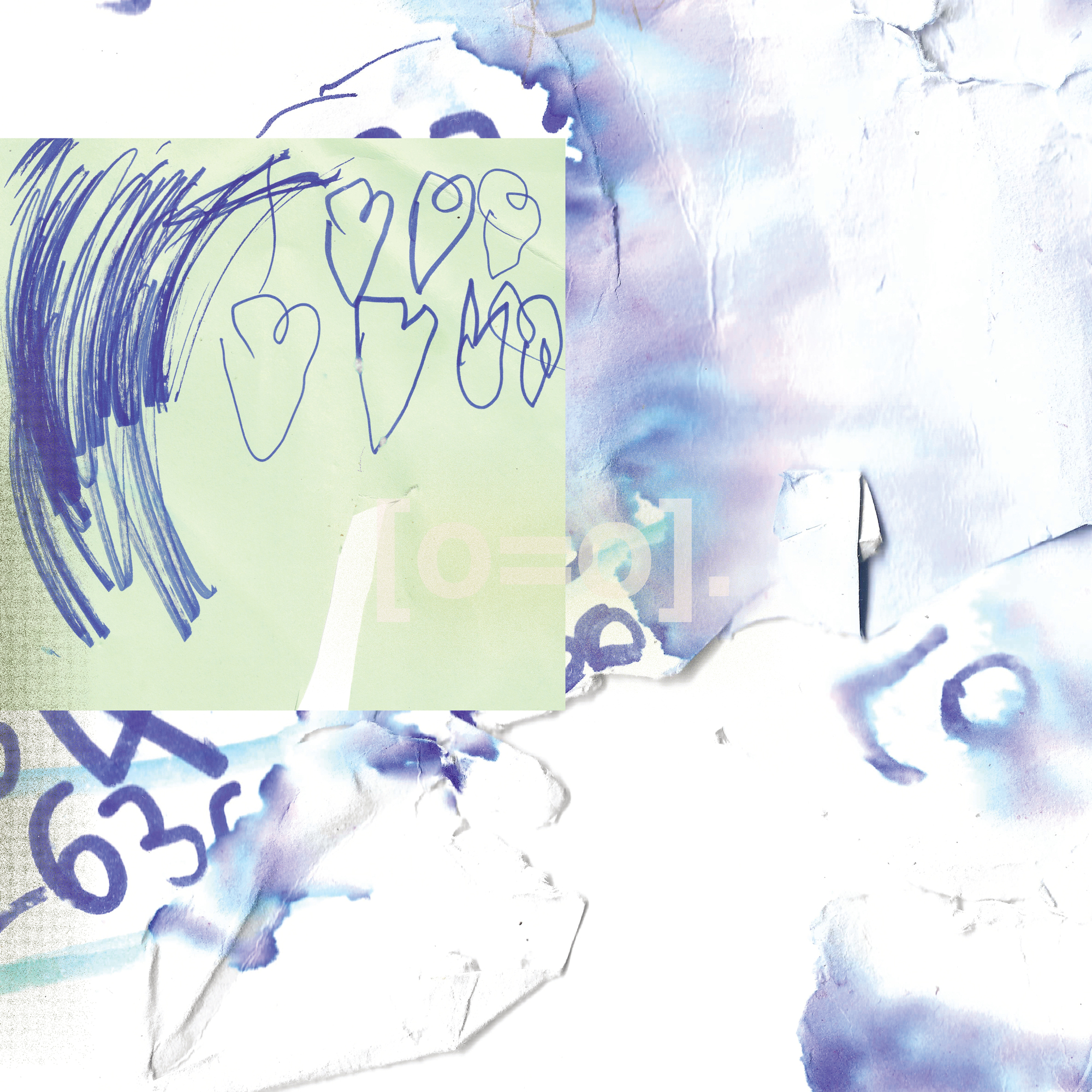
Absolutely, they also unintentionally / intentionally helped me make the artwork. My eldest was just drawing something for herself and she accidentally poured a drink all over it.
LB: Absolutely. I was listening to it and it reminded me a little bit of Tim Hecker. It reminded me of a little bit of Caretaker. It reminds me a bit of that Fourth World stuff. But then totally that stuff kind of maps onto certain shoegaze. You said you started with a melody. So how did you start off? Are you on a piano?
K: I've got a little workstation thing called an OP-1, which I use a lot. And then I've just got a MIDI keyboard. Sometimes I play the bass. I'm trying to visualize the sessions. There's not a whole lot going on in there, you know, just a few interlocking melodies throughout some of the songs, that's pretty much it, melodies effecting melodies and effects effecting melodies etc. and stuff like that, haha.
LB: The songs are all named after colour combinations, is that a nod to synaesthesia which you have?
K: Not necessarily. The colour references in this case are more related to memories and emotions, particularly landscapes and kinds of perspective - visually and personally and how they make me feel, really.
LB: You mentioned your kids before, did they have an influence on the record?
K: Absolutely, they also unintentionally/intentionally helped me make the artwork. My eldest was just drawing something for herself and she accidentally poured a drink all over it.
LB: Classic move.
K: Yeah, she wasn't happy about it at first. She wanted me to get rid of it but I kept it haha - she eventually came round to the idea of me working with it. It became the front cover! Then with the back cover - I started this one, then got my younger daughter to mess about with it, got some water and poured it all over the ink, then she used her hands and a paintbrush to help finish it.
LB: What were your earliest childhood memories of music?
K: I guess as far as experiencing music as a kid, it was definitely FM and AM radio. Then for my 10th birthday I was given a Cascade radio and tape recorder that also had a built-in microphone. You had to listen to the radio to catch a tune you wanted to record, it was so much fun. I’d record a song onto tape and then wait however long, like two, I don't know, two, three hours or whatever and then, oh, it's back on again. Then you had to record it again before the DJ started talking. Sometimes my younger brother and I would create our own radio shows on the tapes. I loved that experience too and then whilst you're doing that you're hearing lots of other music you haven't heard before. Even though it's like music you're essentially being fed.
LB: Were there any artists or records that stand out in the memory?
K: Yeah, Samantha Mumba’s Body II Body, especially when I clocked that the sample is David Bowie’s Ashes to Ashes.
LB: Oh wow!
K: I think the thing I really liked about that tune was the piano, it's like a flanged piano. That's like the main melody at the beginning. It's like a chorus to flange and then there's that kind of crossover, you know, like you hear all those sounds in shoegaze music and I don't know, dreampop like the Cocteau Twins.
I wasn't picking up on all of that at the time. I was like, yeah, that's why I love that sound, that kind of watery, woozy sound. But then the tune was great and she could really dance.
I bought the tape with my pocket money. Maybe I went with my Grandma to Woolworths at the time. That was around the time of Donell Jones - U Know What's Up, too, I think?
LB: The production on that still absolutely stands up.
K: Yeah that was I guess when R&B was really properly pop at the time. But yeah, Top of the Pops man, and Sugababes as well, they're my favorite, well they are my favorite girl group for sure, actually I was in the studio with them last year.
LB: What was that like?
K: That was incredible, man, hopefully some stuff will come out.
LB: We were talking about your own process of sitting down and you're kind of working out a melody and then kind of there are these other sounds and textures that are coming on top. Do you have, is that the same approach when you're producing or is it different?
K: I guess when producing, it really depends on who I’m working with. More often than not, there is definitely room to try things out and just have fun, whilst helping the artists make their records. But yeah with producing the focus is more on kind of helping execute what the artists want to say.
LB: The slow pace of your writing process is well recorded, and you’ve spoken before about how an idea might take six months to germinate and become a thing. Is that the same now or has that changed?
K: It's way quicker now. When your time becomes so fragmented, especially when you have kids, it's just like, I have to just get it down. I can have an idea, I give myself maybe a day to at least get it down and at least start recording it. Finishing it is a whole other thing, but when I really have to finish something I can do it.
LB: What does that look like? Are you just in the studio?
K: Normally when everyone's asleep, that's when I lock in. Or if I have to and there's not much time, I'd go to a studio or something. I'd love to be able to do that more, but because I've got the setup at home there is a convenience in that - being able to roll out of bed and spend time with the fam, but it's also so easy to kind of lose focus.
LB: One thing that's obviously not on the record is like your voice and singing lyrics. Talk me through that, why not have that on there?
K: I just didn't feel like singing, that's literally it. That was probably why I enjoyed making it, to be honest. There wasn't really much for me to say lyrically, I was just trying to get feelings out, and sometimes those feelings don't need words.
LB: Was there ever a plan to sing?
K: When I properly started work on it, after the Center Parcs trip, no, not really. In a way it’s kind of the next step from Songs For Midi, again further stripping things back.
LB: You talked about your first LP being kind of like a purge, you were like, and you referenced something earlier, I can't remember exactly the phrase you used, it was similar to that, it was like a kind of release or letting go of something. Why was that important to you as an artist, that actually that's something that you funnel through the music?
K: Yeah, I guess to an extent that's kind of what making art is, isn't it? You're kind of taking in the world around you, and then at some point it just has to come out. Yeah, I think maybe that's what I meant by purging at the time, but then I think that first record was quite a cathartic record. It was kind of a sad record.
LB: Yeah, maybe a bit melancholic.
K: Melancholic for sure. Just thinking about where I was mentally at the time. Perhaps I’m in a better headspace with this record. Less in my own head as well. Definitely way different. I mean 13 years is such a long time between the two albums. Essentially a different person in that space and time.
LB: How would you think you're different now?
K: I think music is something that's a lot less precious to me, it's something that I'm very grateful to be able to do and still have a huge love for, but it's not a be-all and end-all, like it may have been for me back then. I think there are way more important things in life too. But music is a way I can decompress as well and I love and appreciate it for that, but it's not so much my world, you know. When you're in your early 20s and... your teens or whatever, you're kind of experiencing things for the first time and the emotions are so extreme, you know. I guess there's just a lot less of that now. I'm getting older, but also feeling way younger.